.jpg)


How is corruption linked to leadership?
Corruption is a tempting and powerful weapon that allows people in power to make the distance between them and the common people even greater. It is presented as an innocent idea, but it is then reinforced and pushes people away instead of uniting them. But how can one resist, swim against the tide? It takes a show of independence against the proposal, people must prove that they are honest not only to their team but to themselves. This is not 100% proof of leadership skills, but it reveals to some extent the character of the person, how capable he/she is of choosing the easy and dishonest path instead of the hard and right one. What consequences will follow for those who chose the first option - it will probably not be positive from a purely human point of view. Perhaps it is a way of rising more quickly to the desired position, but ultimately personal choice is decisive.
Corruption is complex and resilient and there are limits to what anti-corruption interventions alone can achieve. Even incremental improvements are difficult to sustain. There is never a simple ‘yes’ or ‘no’ answer to whether anti-corruption efforts work. For example, for development agencies, however, potential success factors include collaboration and coordination, building trust, and seizing opportunities as they arise. It can pay off to build and harness political will and citizen support for good governance, and work to change expectations and reshape the policy arena.

Motivation to participate in Erasmus+
"As a young person participating in Erasmus for the first time, I think I have only had positive experiences so far, and that is why I think I can be a young ambassador for this program from now on, inviting all young people to join, learn and grow, but most importantly to have fun. I just hope this text will motivate you to join Erasmus+ project.
Frist of all do you like to meet new people from different countries and to learn new things about their cultures and tradition? So if the answer is yes you definitely must join Erasmus+ project.
Than if you see yourself as an introvert and a shy person, but you want to break free from your comfort zone and face your fears, this is the place where you’ll feel much better to be involved in group projects, to learn to be open- minded and to trust others and yourselves.
This program teaches us how to be better person, by all means, to be a better citizen for your country, to interact with others and exchange your opinion without any fears. To be an active listeners and to be understanding, but still to be able to defend your opinion and hold your grounds.
Except the educational part there is the fun part. All of our free time here that we spend together hanging out and getting to know each other better, is probably the best experience so far. You will learn probably a few new words form each others native languages, and when you come back home you’ll definitely will be the coolest friend, who knows a lot of friends from so many countries.
You’ll learn to dance other national dances and even to sing a few of their traditional songs.
So in the end you’ll have only positive vibes, new skills and methods.
So if you are that kind of person come and join us and bring us only a good energy."
- a participant in the
YE "Improving MY Leadership skills"

How do I benefit from participating on Erasmus+ Project ?
Erasmus+ is the European Union’s programme for boosting skills and employability through activities organised in the field of education, training, youth, and sport. Youth activities under Erasmus+ aim to improve competences, skills and employability of young people, promote young people's active participation in the society, their social inclusion and well-being in youth work and youth policy at local, national and international level.
Well, first of all, Erasmus + offers opportunities for young people to visit other countries, to learn and to achieve results through non-formal learning. In these projects we develop culturally, we share traditions, we learn to integrate, we enrich our vocabulary, we make friends and unforgettable memories. Through these projects we find ourselves, each with a different topic, discovering things about us, about what we like, we get to communicate much better, to get out of our comfort zone and even change our lifestyle. You get to take with you small things that you will add to your daily routine. For example, you can change your eating style, how you start your day, try to make the day more beautiful for those around you, to understand better those in your country.
In our project we learn about our leadership skills, how to overcome our fears, to be more courageous, more responsible, flexible, how to work in teams which is great for when you find a job because everything it has to be done with colegues, to be reliable, communicative and it will sure be very helpful in our future in the relationship with people.😍😇
Why is it important to have a strong team? How to build one?
Working in a team can be a challenge especially with new people in a new environment. But, here we learned that stepping out of your comfort zone is not as scary as it seems.
Building a strong team is a -must- , especially when the given task requires critical thinking skills and a lot of strength to tackle it. It is more likely for a person to be happier with the results if they are achieved through teamwork in which everyone felt included and felt like their contribution has led to success.
When building a team, it is important to include people with different skills and talents - a more diverse team is more likely to achieve their goal than a homogeneous team. The leader of the team must try not to abuse their power and must always encourage the other participants to give their own ideas and views.

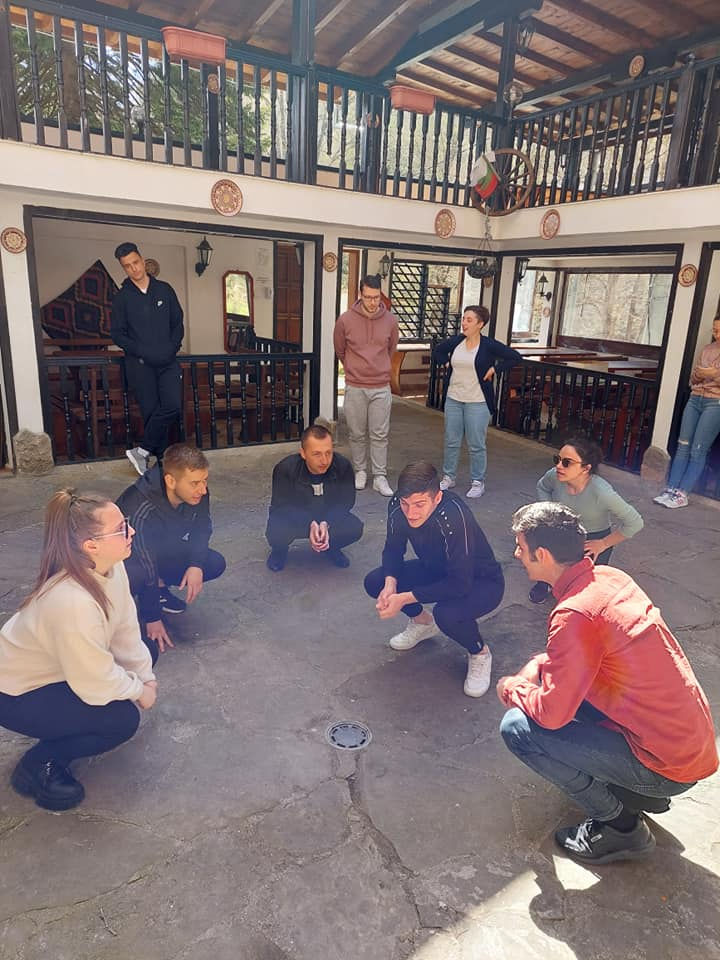

What are the skills a leader needs?
When we talk about someone who is a leader, we often think of a person who is also responsible for sometimes a smaller, and sometimes a bigger group of people. Managing this group of individuals towards success, taking care of each one of them, motivating them and maintaining team spirit, requires a great set of skills.
There are different skills that the leader should be using depending on the theme and requirements of the project, or even the members of the team, like psychological or emotional skills. We have selected a few of larger list of skills, that we think are the most important qualities a leader should have.
1. Open - mindedness- A good leader shouldn’t judge his teammates on any base - religious, gender, sexuality, nationality and etc. In order to bring out the best qualities from each member, they must be able to look through this external and irrelevant features and see how a person can really contribute in order to get the best results.
2. Problem solving- for us this is the most important leadership skill. Leaders spend a significant amount of time putting out fires and solving every kind of issue. They are the ones teammates look to for advice and help, and often have a final say on the course of action. These individuals need to know how to think outside the box, imagine new solutions, predict consequences. This is the quality that separates leaders from the rest of the group. They have to know how to solve problems in group settings, with collaboration from all the members. More input also means a bigger variety of ideas, and a leader should know how to choose the best ideas from the one that are suggested to them.
3. Decision making- Leaders make many decisions, and often these individuals have the final say on tough calls, and many times, need to choose a path without knowing the whole outcome. Moreover, consequences might be horrible, but it is their job to stand their ground, to have the trust from all of the members and to be extremely brave.
4. Persuasion - This skill is the difference between managers and leaders. Managers get team members to follow orders, and leaders get team members to believe and buy into a vision. Great leaders can express the importance of a project and make team members believe in leadership and themselves. Persuasion is an especially useful skill for new leaders, since they are the ones who don’t have any recorded experience and success to prove themselves.
5. Conflict management - Leaders need to know how to stay calm, because other members look to leaders for social cues. When leaders stay calm, the team also stays calm, and if the leader is optimistic then the team tends to be as well. Leaders need to know how to process and overcome difficult emotions, ignore overreactions, and keep a clear, logical head even amongst chaos. Leaders who are in control of their thoughts and feelings anchor the team and give teammates the strength and support needed to perform well.

What is forum theatre and how it works?
Forum theatre is a type of theatre created by the innovative and influential film director practitioner Augusto Boal, one of the techniques under the umbrella term of Theatre of the Oppressed (TO). This relates to the engagement of spectators influencing and engaging with the performance as both spectators and actors, termed "spect-actors", with the power to stop and change the performance. As part of TO, the issues dealt with in forum theatre are often related to areas of social justice with aims to explore solutions to oppression featured in the performance.
How can we use theatre for creative problem solving? This type of theatre incorporates the ability to recreate life in words in its external and internal manifestations. And in order to recreate something you need to have creative thinking. The theatre also develops the combination of images, intuition, ingenuity and the ability to improvise. And these are the elements of creative thinking. The essence of this type of theatre is to search within the framework of the proposed performance, together with the team, to find a solution or a way out of any situation.
One of the most important rules not only in life, but also in the forum theatre, is for the aggressor, the victim and the witness. It states that you cannot change the aggressor in the show. The victim may get his chance for retribution, but not in every performance, and the witness can change the whole situation.
From the training hall to real life - how can we connect the activities we did on the project with real life (Or who are Galileo and Mariika?)
Participating in such an Erasmus + project can often make you think about many topics related to leadership, but also about issues related to society as a whole. At the end of each "game" you come up with a lot of new knowledge that you can use in your daily life.
At the “Improving MY Leadership skills” project, we played the Galileo game, and the lesson we learned from it was to always question the authorities in our lives. Even if they are reliable and experienced people that many trust, the question we should always ask ourselves is "Why?".
Blind trust in the authorities always has bad consequences, and their power over us as individuals will only increase, so that in the end we are left without the right to choose or have our own opinion. In real life we can transfer this knowledge in many situations. It is important to know that we always have the right to oppose, to have our own opinion, to be free to protest and to sign petitions.
Non-formal education can often surprise us and reveal many new things, even for ourselves. Another activity, revealing the story of Mariika and Ivancho, made everyone think about who is really their close friend, depending on which side of the story they defended. Some of us have been supporters of true love and have agreed that when we are in love with someone, we must go all the way, regardless of the consequences. Others defended Peter as a true entrepreneur, as a man who saw in the whole situation a benefit only for himself. Others agreed with Ivancho's decision not to forgive Mariika for her actions… What happened to our heroes is just a story about life and the illusion of a simple choice.
Through forum theater, we changed the course of the "tale" and the key decisions made by the main characters. We realized that there is always a chance for more opportunities and we must always think carefully about the consequences of our own decisions. We also learned that nothing is so simple, and the choice is ours alone.


The types of leaders
How to be a good leader? What is leadership? The types of leaders.
Some people think they are natural leaders. However, critical situations show otherwise. You never know how you would react when your team is under pressure. Problem solving and conflict management are the key qualities of the great leader. One might think one possess them but only when an issue occurs one would actually see if one has them.
It is interesting how a leader is chosen by the team, sometimes without even knowing. People are the best judges of character. They feel whom they can trust, feel the power one radiates and follow the chosen. It is a natural process of voting without voting. And in such scenarios, rarely is the public wrong.
Every leader has a second. It is the person who always has their back, who also knows how to make tough decisions and who is not any less smart. Nevertheless, this person doesn't want to be in the spotlight. They back up the leader and are perfectly fine with this position.
Last but not least is the person who is quiet and shy but in the right moment, they give a solution no one has thought about. It is usually something rather strange, something that doesn't seem to be the right choice or the practical one, but in the end, it turns out to be the best possible decision. And this person, whether they want it or not, becomes the leader.
So here comes the question - do you think you are capable of being the head of a team? Would you be a good leader? Or are you?


What are the differences between a leader and a manager?
Manager – An employee of the organization, responsible for its management. Leader – A person who leads, guides, and directs others. There is always a buzz when we talk about the terms leader and manager.
In an organizational setup, a manager is an important link between the firm and its stakeholders, i.e. employees, customers, suppliers, shareholders, government, society, and so forth. He is the one who performs basic managerial functions.
Conversely, a leader is the one who inspires, encourages, and influences his men, to work willingly, in the attainment of the organization’s objectives. The two are not one and the same thing, however, one can only become a successful manager, when he/she is an effective leader.
In this context, what you need to know is that Leadership is a skill, and the person who possesses this ability is known as a Leader. On the other hand, Management is a discipline, and the practitioner of this discipline is known as the Manager. This write-up contains the differences between leader and manager.
Definition of leader
A leader refers to a person who leads others in a specific situation and is capable of heading the group towards the accomplishment of the ultimate goal by making strategies to pursue and reach the same.
A leader has a vision, who inspires people, in such a way that it becomes their vision.
Further, the leader can be any person having the potential to influence others, be it a manager of an organization, or head of the family, or a captain of a team, minister of a state, or leader in an informal group. He/She is the one who:
Takes charge of and directs the activities of subordinates.
Provide the group everything that is required to fulfill its maintenance and needs related to the task.
Required at all levels to act as a representative of the organization
Encourages the whole team to work together and supports them in accomplishing their tasks, as a guide.
Now, you must be wondering, Why people follow a leader? Well, it is because the behavior of people is influenced by the leader. And that is why a leader can exercise power over them.
Qualities of a Leader
Foresightedness: To predict and make plans for the future.
Intelligence: To integrate and interpret relevant information.
Creativity: To have unique, innovative, and original thinking.
Enthusiasm: To remain energetic, show interest, and think positively.
Charisma: To attract and influence people.
Decisiveness: To take quick and appropriate decisions.
Self Confidence: To trust their competencies and have confidence in their abilities.
Bravery: To take the first move, to bring change in certain situations.
Types of Leader
There are mainly four types of leader:
Transactional Leader: These leaders use social exchanges to influence followers, i.e. they motivate by rewarding the subordinates for their productivity and this induces them to work towards the achievement of the goal.
Transformational Leader: Such leaders encourage and awaken followers to make efforts in achieving extraordinary outcomes. He/She is someone who comes forward to change things.
Charismatic Leader: He/She is one such leader whose energy, enthusiasm, and charisma often motivate people to behave in a specific manner. He derives his power from exemplary character and heroism.
Visionary Leader: Visionary Leader is the one who has the potential to develop and pursue the vision, which is not just realistic but achievable too. He possesses psychological attractiveness, due to which people get influenced towards the leader’s dreams.
Definition of Manager
Manager – An employee of the organization, responsible for its management. Leader – A person who leads, guides, and directs others. There is always a buzz when we talk about the terms leader and manager.
In an organizational setup, a manager is an important link between the firm and its stakeholders, i.e. employees, customers, suppliers, shareholders, government, society, and so forth. He is the one who performs basic managerial functions.
Conversely, a leader is the one who inspires, encourages, and influences his men, to work willingly, in the attainment of the organization’s objectives. The two are not one and the same thing, however, one can only become a successful manager, when he/she is an effective leader.
In this context, what you need to know is that Leadership is a skill, and the person who possesses this ability is known as a Leader. On the other hand, Management is a discipline, and the practitioner of this discipline is known as the Manager.
This write-up contains the differences between leader and manager.
FUNCTIONS OF MANAGERS
Planning: The planning function encompasses setting up goals, formulation of strategies, and development of plans to coordinate the activities of the organization.
Organizing: Organizing involves the arrangement of resources and scheduling of tasks so that activities can be performed in a sequential manner.
Staffing: This function involves recruiting the right personnel for various positions in an organization.
Directing: Directing involves providing direction, guidance, and supervision to the subordinates, so that they can perform the task effectively.
Controlling: Controlling involves keeping a check on the activities performed by the employees so as to make certain that they are performed as planned, by making comparisons. And if there are any deviations then, measures should be taken to improve them.
Seven Things Great Leaders Always Do
Seven differences that he sees between leaders and managers. They are:
A great leader connects daily work with great goals. Where manager focuses only on the short-term.
A great leader thinks of people as people. Where manager sees only titles or organizational charts.
A great leader wants to earn respect. Where manager wants to be liked.
A real leader is thrilled when team members achieve great things. Where manager is threatened.
A great leader empowers people with honesty and transparency. Where manager parcels out information as if it costs him personally.
A great leader understands that if the team falls short, he is responsible. Where manager blames the team.
A great leader cares mainly about results. Where manager is more concerned with process.
No matter what personality elements you feel make the difference between a leader and a manager, we tend to all strive towards becoming a leader.
The spider web - What did we learn?
We have been divided into two teams, and each team had to build two “spider web” between two trees, using a thin rope and scissors. The ground rules were without touching the rope, every team mate should come out through different hole of the web, and nobody could go under it. Each team had an appointed judge, to make sure we were following the rules.
In beginning it was really chaotic, the ones that were more flexible than the others already passed on the other side, and that is when we actually gave chance to the judges to tell us about their final rule, and it was that those who already passed through a hole, can’t come back on the other side to help the others. So at start we rushed and we made a lot of mistakes, not giving ourselves enough time to think about any kind of strategies or appointing a leader, thinking only about winning.
Than we started from the begging and with a good strategy, but our leader was nowhere to be found yet. Also at the end our dear friends from Romania decided to add another rule, we had to chose only two members from each team that could use words to communicate, and the other members had to be creative in order to keep communicating and finish the game. The task was hard and almost everyone tried to cheat or bribe the judges, but at the end we all finished the game and we were all celebrating on the other side of the web.
This game for sure made us closer as a team, and in order to finish we really had to actively listen to everyone, to be cooperative and truly problem- solving oriented. For us all to go through a different hole, we had to think of a good strategy, to be very creative, proactive and logical. Also I and some other members were pretty scared or shy, and when others noticed that, they were truly supporting and understanding, and there is nothing better than a good pep talk. Keeping a a good team spirit by motivating the others was for me the key to our group success. And probably this was the time when some members stepped up as leaders. The most surprising part for me, as a person who doesn’t like public speaking in front of a bigger groups of people, came after we finished the game. The judge who gave the final rule about excluding words like a form of communication, told us that for that round we have all finished way more quickly than the other rounds. He asked for everyone’s opinion on why do we think we did better in specifically that round?
The true answer to his question was that from all the tools we use for communication, only ten percent are actual words, everything else is body language, such as gestures and positioning the body or some of it parts. In conclusion I see this as way for me to improve my outside appearance and public speaking skills, without using many words, especially when using a foreign language. In the there is hope for everyone, even the shy ones or the introverts, we might not be that confident, but we are here, breaking out of our comfort zone, facing our fears, participating and enjoying ourselves. We maybe don’t have everything figured out, but that is OK, no one has, and as some of the most confident public people told us, time after time again: “Fake it until you make it”.
